
Calories: Why They Matter and Why You Don’t Need to Fear Them
Does it ever feel like you’re constantly hearing about calories?
“You need to be in a deficit to lose weight!”
“X amount is plenty!”
“I don’t eat food X because it has too many calories!”
The conversation around calories can feel exhausting and overwhelming, and it’s often oversimplified.
Calories aren’t something to fear, but they’re something to understand. Calories are often blamed for weight gain, and sometimes by extension, poor health. But in reality, it’s not that simple.
To understand nutrition better, it helps to understand what calories actually are and what they do in the body. A calorie is a unit of measurement that measures the amount of energy in a food or drink. Calories come from macronutrients in food: carbohydrates, protein, and fat. The higher the calorie count, the more energy the food or drink contains.
Calories themselves aren’t bad for you, but many times they get a bad rep. This reputation likely comes from ultra-processed foods, which are often high in calories but low in nutrients. These foods are easy to overeat and may contribute to unwanted weight gain and other health concerns.
But here’s the important part: You need calories to stay alive.
Calories provide the energy your body uses to power everything, from brain activity to breathing, circulation, and cell repair. At first, a lack of calories may feel like being tired or run-down (the body is literally low on energy), but if it continues, it can cause serious deficiencies and illness. And, if you are trying to get stronger in the gym, cutting calories too low can backfire, stopping muscle gains and fat loss.
So, if calories are simply units of energy, the next logical question becomes: how many do you actually need?
How Many Calories Do I Need?
This may make you wonder how many calories you should actually be eating. The classic “2,000” calories a day is just a guideline. Not everyone needs 2,000 calories a day, and some people may require more. The number of calories you need depends on age, biological sex, height, weight, health status, and activity level. Learning how much you need for your body can help you make food choices that keep your body within the weight range you want.
You can use this calculator from NASM (National Academy of Sports Medicine) to get a general estimate of your calorie needs: Calorie Calculator
When it comes to calories and body weight, in most situations, it boils down to calories in versus calories out. An example would be, if you eat 2,000 calories a day but your body only uses 1,600, the remaining 400 calories may be stored for later use, which can lead to weight gain over time. If you eat 1,600 and use 1,600, your body is in maintenance, and you will not gain or lose weight. On the other hand, if you eat 1,600 but burn 1,800, your body is in a calorie deficit and will lose weight if this is done consistently. *These numbers are for examples only and may not reflect your personal needs*
Once you understand what calories are and how many you need, the next step is learning where to find that information on the foods you eat.
Food Labels:
Reading food labels can help you make better food choices and keep within your caloric limits. Packaged foods often contain a nutrition panel. Nutrition panels provide information on how many servings are in a package, the amount of a single serving (weight, number, or cups and tablespoons), the number of calories per serving, and what nutrients that serving contains.
Looking at the nutrition panel can help you understand portion sizes and avoid unintentionally over- or undereating. The example below is from a box of Cinnamon Toast Crunch. The label shows that there are about 8 servings per box, and that each serving is 1 cup. This means there are about 8 cups in the box. If you measured 1 cup of the cereal and ate it without milk, you would get 170 calories. If you were to add milk or eat more cereal than 1 cup, you would be consuming more calories. If you are trying to lose weight, eating more than the recommended 1 cup may be preventing you from reaching your weight loss goal.
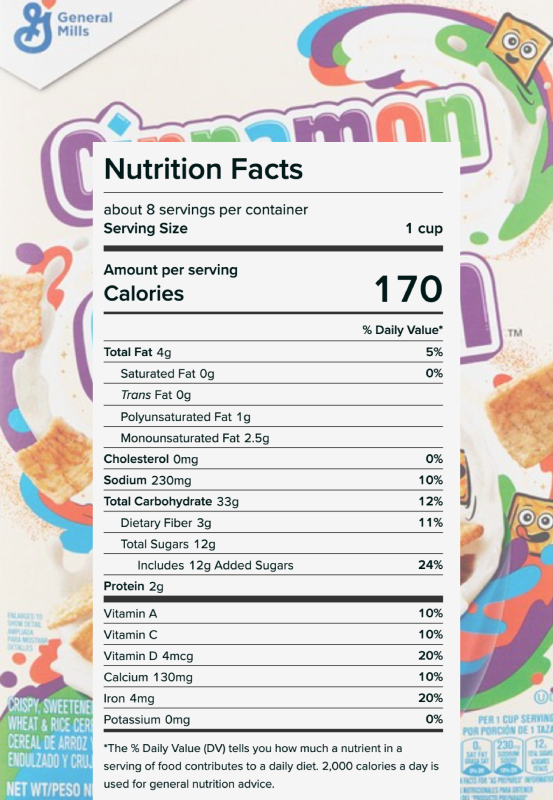
The percent daily values on nutrition panels are based on a 2,000–calorie diet. So, if you need fewer or more than 2,000 calories, you may need to adjust your serving sizes.
But calories alone don’t tell the full story about food. Nutrients matter too.
Nutrients Matter Too:
Calories aren’t the only thing that matters. Foods can be both high or low in calories and still be nutrient-dense, just as they can be low or high in calories and lacking nutrients.
Calorie-dense foods contain more calories per serving, while nutrient-dense foods provide more vitamins, minerals, and beneficial compounds relative to their calories.
For example, a medium apple has about 95 calories and is rich in fiber and vitamin C, compared with an apple-flavored rice cake, which has about 50 calories and very little nutritional value. Although the rice cake has fewer calories, the apple provides fiber to help keep you full, prebiotics to support gut health, and vitamins and minerals your body needs and loves.
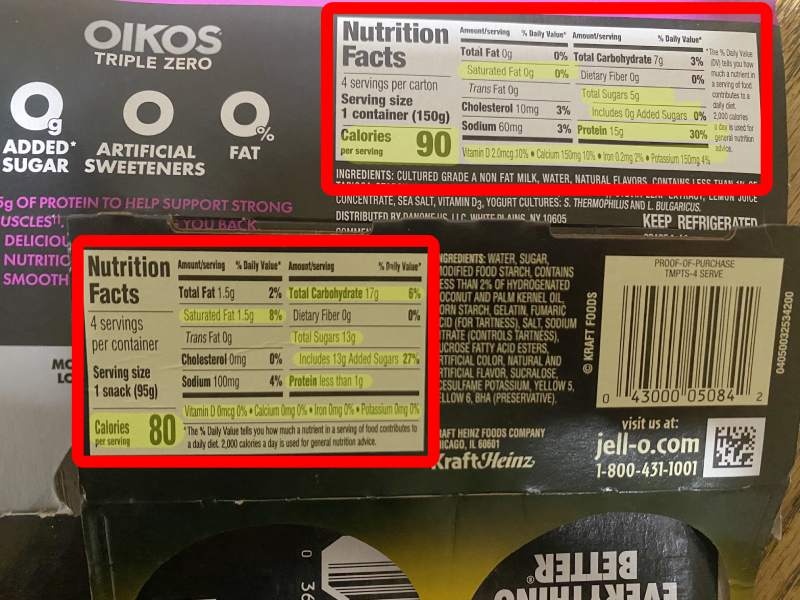
Below is another example of how calories can be misleading. One of the items pictured is the food label for an Oikos Greek Yogurt, and the other is a Jello Temptations. The Jello Temptations comes in at 80 calories compared to the yogurt, which has 90. From a numbers-only perspective, the Jello seems like the better option. But for only ten more calories, you are providing your body with protein, vitamin D, calcium, and probiotics, all of which the Jello is lacking. Nutritionally speaking, the yogurt is the healthier choice.
Other foods, such as nuts, nut butters, seeds, olives, cheese, hummus, eggs, and dark chocolate, are higher in calories but also nutrient-dense. Because these foods are calorie-dense, it’s helpful to enjoy them in moderate portions so the calories don’t add up too quickly. They contain vitamins and minerals that your body loves and needs, but the calories can add up quickly, leading to weight gain if overeaten. You don’t need to give up high-calorie foods entirely, and removing entire food groups from your diet can actually create nutrient gaps that lead to vitamin and mineral deficiencies. This is why it’s better to eat them in moderation.
Should I Track Calories?
Tracking calories is a personal choice, but it’s not necessary. There are several calorie-tracking apps available, but some items listed in their libraries or data are inaccurate, particularly because user-generated data may be miscalculated. If you choose to use a calorie-tracking app, keep its limitations in mind.
There are other methods that can help maintain reasonable food portions without needing to write, track numbers, or weigh and measure food. One of the easier methods is to use hand portions as a guide. You don’t need to actually hold the food in your hand, but you can use your hand as a visual reference. Because most hands are proportionate to the body, the hand portion guide is convenient and relatively accurate.
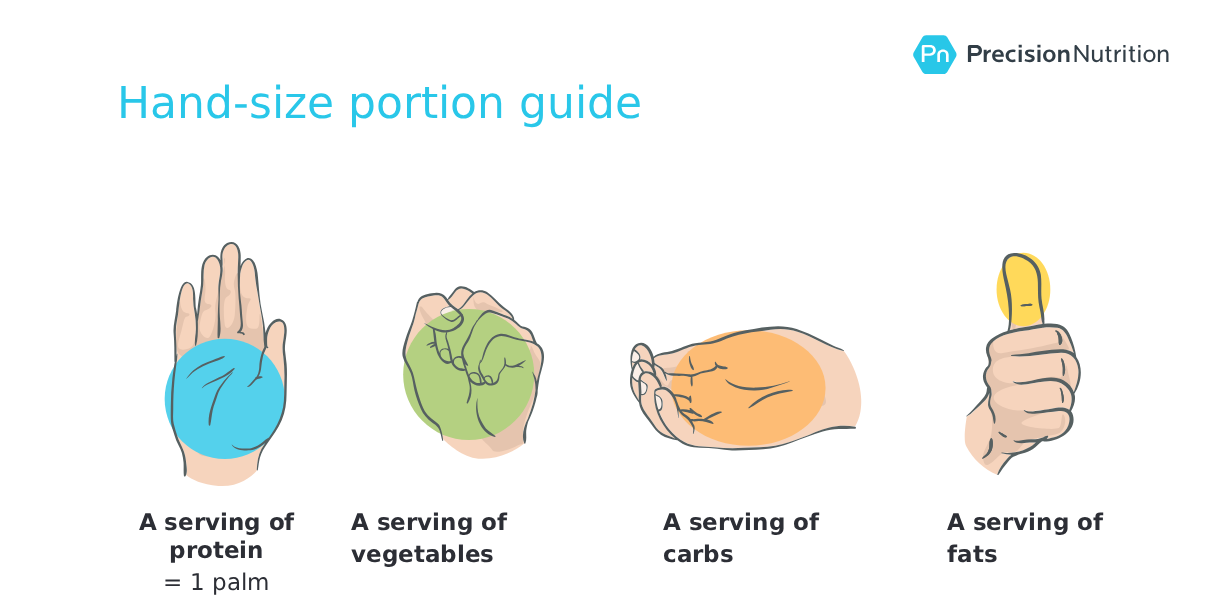
Image belongs to Precision Nutrition
The takeaway:
Any food can contribute to weight gain if it’s consistently overeaten, but food shouldn’t be avoided simply because of its calorie content. It’s important to understand the right calorie counts and serving sizes for your body so you can fuel it properly with nutrient-rich foods without gaining unwanted weight or undereating and feeling tired and rundown.
Something to Think About:
What’s one food you’ve avoided because of calories alone? It might be worth taking a second look at the nutrients it provides.
Remember: this post is for informational purposes only and may not be the best fit for you and your personal situation. It shall not be construed as medical advice. The information and education provided here is not intended or implied to supplement or replace professional medical treatment, advice, and/or diagnosis. Always check with your own physician or medical professional before trying or implementing any information read here.