
How Habit Loops Can Keep You Stuck in Your Weight Loss Journey
Have you ever found yourself elbow-deep in a Pringles can after a long, stressful day?
Okay, so maybe it’s not a Pringles can. Maybe for you, it’s an iced latte with an extra espresso shot every morning because getting to bed on time feels impossible. Maybe it’s a supersized burger combo at lunch because you skipped breakfast and are absolutely starving. Or maybe you always order a large Coke with your salad… because that’s what Mom did.
The truth is, life is complicated. There are many reasons we do the things we do, what we eat, why we eat, and when we eat. Some behaviors are lifelong patterns shaped by how we grew up. Others develop as a way to reward ourselves, cope with stress, or simply get through the day.
That yummy snack or glass of wine is totally fine on occasion. But when we start relying on food or drinks to solve our problems, or when we eat purely out of habit, it can derail our health and weight-loss goals.
Let’s picture how this can appear in real life:
Imagine a woman named Shelly. Shelly is 38 and a single mom of two kids, one in elementary school and one in middle school. She also works a stressful customer service job.
After a long day, Shelly clocks out exhausted, hungry, burned out, and ready to throw in the towel. But quitting isn’t an option. She has kids, bills, and responsibilities. Before starting dinner and helping with homework, she decides to relax on the couch with her favorite bag of chips.
Forty-five minutes later, Shelly has eaten about half the bag and feels noticeably better. She gets up, helps the kids with homework, and starts dinner. For her, this is normal. It’s how she unwinds.
Or let’s consider Sara.
Growing up, Sara was required to finish everything on her plate. If she didn’t, part of her allowance was taken away to “pay” for the food she wasted. As she got older, that rule turned into a habit. Now, as an adult, Sara feels compelled to clean her plate even when she’s already full.
Both Shelly and Sara are stuck in what’s called a habit loop.
A habit loop is a cyclical pattern that looks like this:
Trigger → Behavior → Relief/Reward
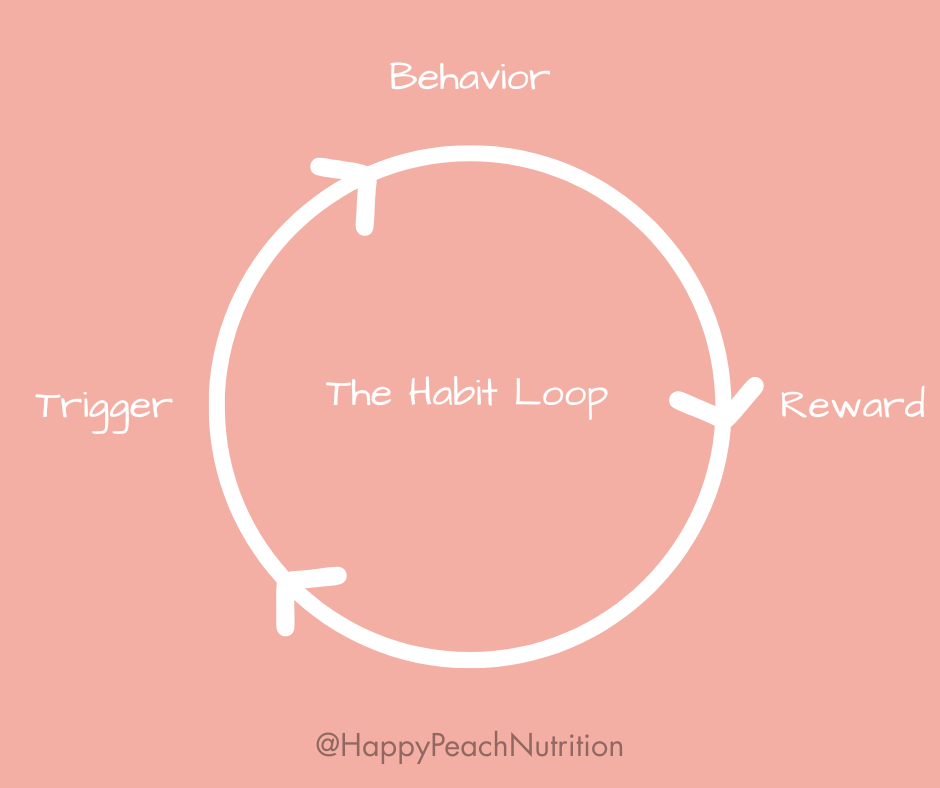
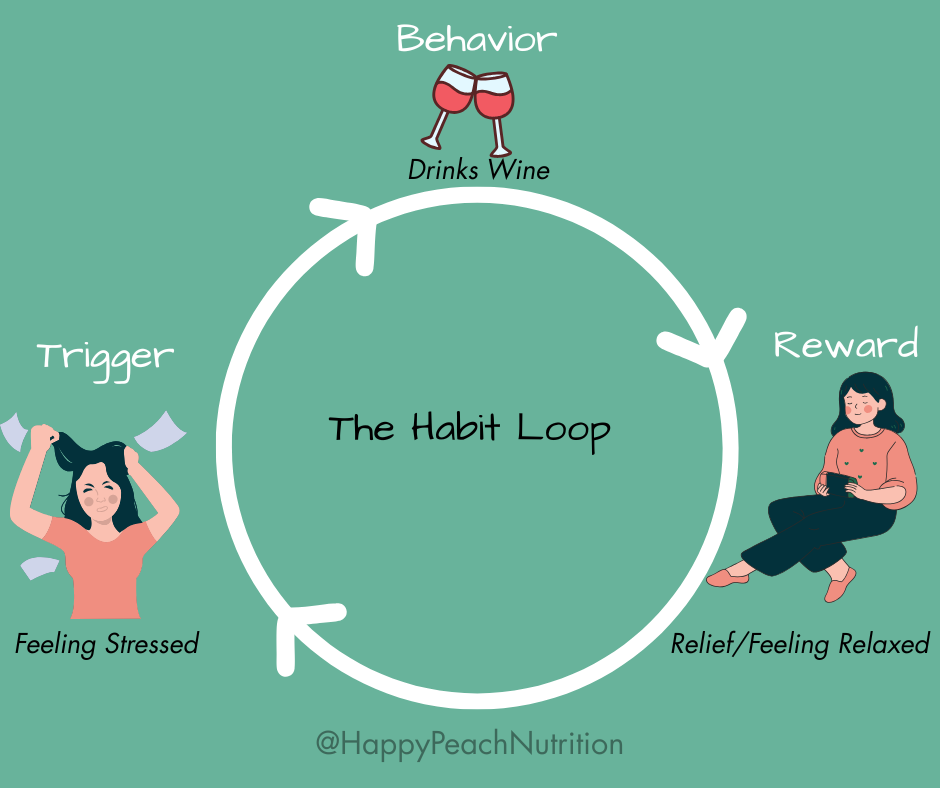
Something happens (the trigger), which leads to a behavior, followed by a reward, usually some form of relief or comfort.
For Shelly, the trigger is a stressful workday. The behavior is eating chips. The reward is relaxation. For Sara, the trigger might be seeing food left on her plate. The behavior is finishing it. The reward is avoiding guilt or discomfort.
Habit loops can look different for everyone. Triggers don’t have to be emotional; they can be a time of day, a place, or even a specific person. The behavior is the action you take in response to the trigger, and the reward is what keeps the habit going. Sometimes the reward is pleasure, and sometimes it’s simply avoiding an uncomfortable feeling.
And here’s the important part: habit loops themselves aren’t bad.
For example, someone who takes a walk after dinner every night to relax and aid digestion is also following a habit loop:
Finished dinner (trigger) → Walk (behavior) → Relaxation and comfort (reward)
The problem arises when the behavior is unhealthy and happens regularly, like eating half a bag of chips every evening, drinking alcohol to cope, or polishing off a pint of ice cream whenever emotions run high.
To change an unhealthy habit loop, you first need to identify both the trigger and the behavior that follows it. That takes awareness, and it’s not always easy. Many habits are automatic, especially if they’ve been around for years.
Some people find it helpful to work backwards:
1. Start with the reward.
What did it do for you? Did it soothe you? Distract you? Bring up a comforting memory?
2. Connect the reward to the behavior.
What did you do to get that feeling? Did you have a couple glasses of wine? Snack while zoning out? Reach for something nostalgic?
3. Identify the trigger.
What happened beforehand? A stressful workday? An argument? Seeing or smelling something that brought up old emotions?
This process can take time and may surface uncomfortable feelings, but that’s also where real change begins. Once you identify the trigger or the behavior (or both), you can start experimenting with replacements.
If your trigger is tied to something more complex, such as trauma, abuse, or an eating disorder, I strongly encourage you to work with a qualified healthcare professional.
Sometimes the trigger can’t be removed. It might be your job, your environment, or even a person. In those cases, focusing on changing the behavior is often more realistic and within your control.
This might mean replacing a food-related behavior with something non-food-related, like:
· Listening to music
· Going for a walk
· Watching a show or YouTube video
· Listening to a podcast
· Playing a video game
· Reading
· Drawing or coloring
· Sewing
· Playing with a pet
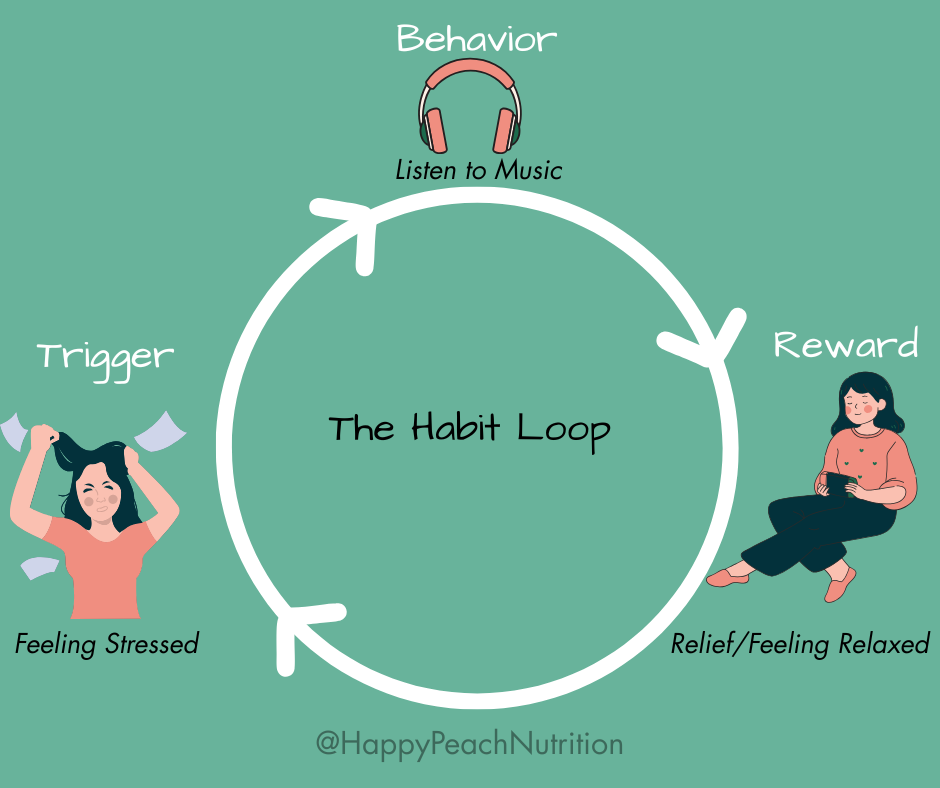
When you feel triggered, try engaging in a different behavior and see if it gives you the same sense of relief. If it doesn’t, that’s okay; you may need to try a few options before finding what works for you.
Breaking old habits takes practice. Be patient with yourself. Simply recognizing that you’re stuck in a habit loop is already a win, because awareness is the first step.
Remember: this post is for informational purposes only and may not be the best fit for you and your personal situation. It shall not be construed as medical advice. The information and education provided here is not intended or implied to supplement or replace professional medical treatment, advice, and/or diagnosis. Always check with your own physician or medical professional before trying or implementing any information read here.